Thousands of drivers cross it without giving it much thought.
Cars move along Frankford Avenue through Holmesburg, passing over Pennypack Creek on the way toward Mayfair, Torresdale, or points farther north. The crossing feels like an ordinary part of Northeast Philadelphia traffic.
It is anything but ordinary.
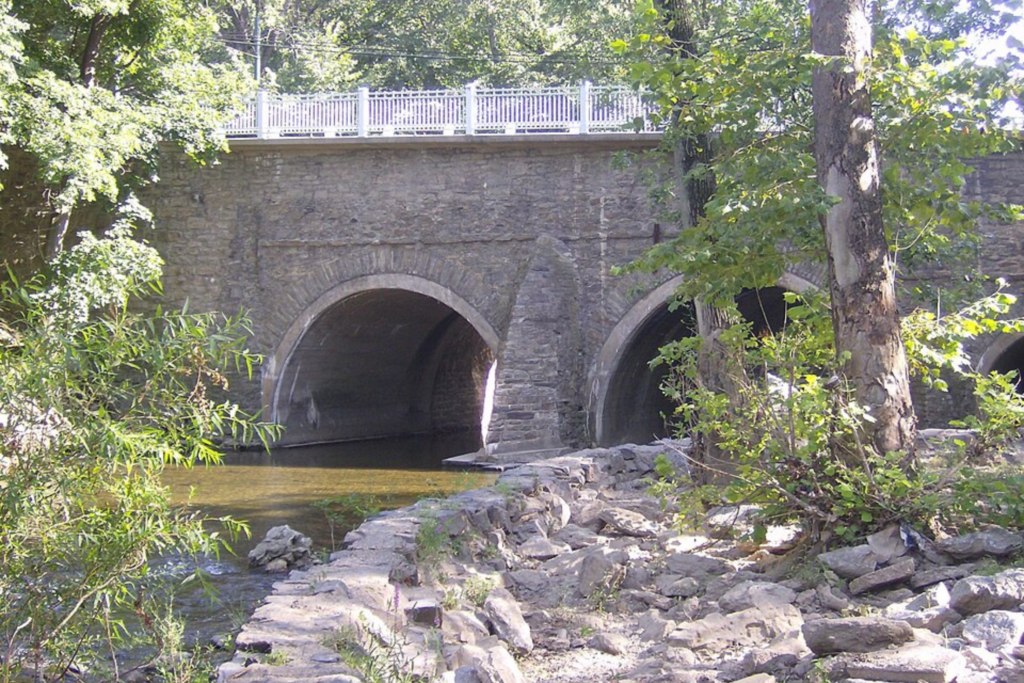
Beneath those cars sits a stone bridge whose history reaches back to 1697. The Frankford Avenue Bridge, also known as the Pennypack Creek Bridge and King’s Highway Bridge, is widely recognized as the oldest surviving roadway bridge in the United States. More than three centuries after its construction, it remains part of an active Philadelphia street.
Long before SEPTA buses, automobiles, utility lines, or the neighborhoods surrounding it took their modern shape, travelers crossed Pennypack Creek at this same location.
The bridge has carried horses, wagons, stagecoaches, streetcars, early automobiles, and generations of Northeast Philadelphia drivers. It has also outlasted wars, revolutions, industrial expansion, changing neighborhoods, and nearly every transportation technology imagined by the people who built it.
For a neighborhood landmark, it has an extraordinary story.
Why Was a Bridge Built Here in 1697?
To understand the bridge, start with the road.
Frankford Avenue follows part of what was once the King’s Highway, an important colonial transportation route connecting Philadelphia with communities to the north and ultimately helping travelers move toward New York.
Pennypack Creek stood directly across that route.
Before a permanent crossing existed, travelers had to ford the creek. That might have been manageable under favorable conditions, but a growing colony needed dependable roads connecting settlements, markets, ports, and centers of government.
The Pennsylvania Center for the Book history of the Frankford Avenue Bridge traces the need for the crossing back to William Penn. In 1683, Penn requested bridges along the King’s Highway, including one across Pennypack Creek. Colonial law required local inhabitants to help construct crossings along the route.
The Pennypack bridge was completed in 1697.
Think about that date for a moment.
Philadelphia itself had been founded only about fifteen years earlier.
The United States did not exist.
George Washington had not been born.
The Declaration of Independence was nearly eighty years away.
Yet the basic crossing created by those early builders still forms part of Frankford Avenue today.
A Bridge Built From Stone and Intended to Last
The original bridge was a stone arch structure built to carry the King’s Highway across Pennypack Creek.
Stone arch construction uses compression to move the weight of the bridge outward through the arch and into its supports. When properly built, the design has extraordinary durability. The Frankford Avenue Bridge has demonstrated that durability for more than three centuries.
The Encyclopedia of Greater Philadelphia’s history of Philadelphia bridges describes the Pennypack Creek crossing as constructed between 1697 and 1698 and reports it as the oldest roadway bridge in the United States.
The bridge visitors see today is not untouched from the seventeenth century. A structure carrying traffic for more than 300 years has naturally required changes.
It was widened as traffic increased. The roadway was improved as transportation changed. Major work in the nineteenth and twentieth centuries adapted the crossing for streetcars, trackless trolleys, and modern automobiles.
The remarkable part is what remained through all of those changes.
The old stone arches kept doing their job.
The King’s Highway Became a Major Travel Route
The bridge did not immediately face the traffic associated with later Frankford Avenue.
That changed as Philadelphia grew.
By the eighteenth century, the road through Frankford had become an increasingly important route between Philadelphia and northern destinations. The bridge was widened as early as 1740 to accommodate heavier use.
Then came the stagecoach.
In 1756, stagecoach service began between Philadelphia and New York. The trip took roughly three days, and the route included Frankford Avenue and its crossing over Pennypack Creek.
Imagine beginning a trip to New York that required three days rather than a little over an hour on a train.
For those travelers, this bridge was not a historical attraction. It was transportation infrastructure.
The same remained true as travel became faster. By the late eighteenth century, improved coach service had dramatically shortened the journey between the two cities.
The bridge kept carrying the traffic.
John Adams Crossed It on His Way to Philadelphia
The most interesting part of the bridge’s story is not only its age. It is the number of important moments in American history that passed directly over it.
In August 1774, John Adams traveled across the bridge while heading toward Philadelphia and the First Continental Congress.
At that point, nobody crossing Pennypack Creek knew exactly where the political crisis between the American colonies and Great Britain would lead.
Delegates were gathering in Philadelphia to debate how the colonies should respond to British policies. Independence was not yet a settled outcome.
The bridge stood along their route.
Today a driver might cross it while worrying about traffic or wondering whether the next light will turn red. In 1774, travelers crossing the same creek were heading toward meetings that helped shape the creation of the United States.
News of Lexington Crossed Pennypack Too
The following year brought another remarkable journey.
In April 1775, fighting broke out at Lexington and Concord in Massachusetts. News needed to travel south quickly.
An express rider carrying word of the Battle of Lexington traveled through the region and crossed the Frankford Avenue Bridge on the way to Philadelphia.
There were no telephones, radio broadcasts, news alerts, or internet updates. Information moved at the speed of a horse and rider.
The road over Pennypack Creek therefore became part of the communication network through which Philadelphia learned that armed conflict had begun.
The stone bridge had already stood for nearly eighty years.
George Washington Crossed on His Way to Become President
The bridge’s connection to early American history continued after the Revolution.
In 1789, George Washington traveled across the bridge while heading north toward New York City, which then served as the nation’s capital.
His destination was his presidential inauguration.
By then, the political world had changed completely from the one John Adams had traveled through fifteen years earlier. The colonies had declared independence, fought a war, formed a new government, and elected Washington as the first president under the Constitution.
The bridge was still there.
Few ordinary pieces of transportation infrastructure offer such a direct physical connection between colonial Pennsylvania, the Revolution, and the beginning of the American presidency.
Frankford Avenue Grew Around It
The nineteenth century transformed Philadelphia and the communities north of the old city.
Roads became busier. Industry expanded. Population spread outward. Horses and wagons shared routes with new forms of transportation.
The bridge changed along with them.
In 1803, the roadway was improved as the route became part of the Frankford and Bristol Turnpike. A toll operation also became associated with the crossing.
By the end of the nineteenth century, streetcars created another transportation challenge. The bridge underwent substantial widening in 1893 to accommodate heavier traffic and changing road use.
Five years later, in 1898, John F. Fluehr founded his funeral business in Kensington.
That shared timeline creates an interesting connection between two Northeast Philadelphia stories. The bridge had already watched the city transform for two centuries when Fluehr began serving Philadelphia families. The funeral home would eventually move farther into the developing Northeast and establish its Mayfair presence.
The history of the firm is preserved on the John F. Fluehr & Sons history and About Us page, tracing its beginnings in 1898, its move into Mayfair, and the establishment of the Cottman Avenue funeral home in 1937.
Both stories are reminders of how much history sits inside places Northeast Philadelphia residents pass every day.
The Bridge Adapted to the Automobile
By the twentieth century, nobody building roads was designing primarily for horses and stagecoaches.
Cars changed everything.
The bridge underwent additional work, including significant alterations in 1950 that helped accommodate trackless trolleys and modern vehicle traffic.
Frankford Avenue eventually became part of U.S. Route 13, keeping the colonial crossing connected to a major transportation route centuries after the King’s Highway brought travelers through the same location.
That continued use separates the Frankford Avenue Bridge from many historic structures.
It is not a preserved bridge sitting behind a fence.
It still works.
People drive over it to get to work, school, church, stores, family homes, Pennypack Park, and everything else that makes up an ordinary Northeast Philadelphia day.
History is carrying traffic.
Recognition Arrived Long After the Bridge Did
By the twentieth century, preservationists and engineers increasingly recognized just how unusual the bridge was.
In 1970, the American Society of Civil Engineers designated the bridge a National Historic Civil Engineering Landmark.
In 1988, it was added to the National Register of Historic Places.
Those recognitions formalized what Northeast Philadelphia already possessed: a surviving piece of seventeenth century engineering still performing its original basic purpose.
The bridge reached its 300th anniversary in 1997.
Most structures do not survive 300 winters, floods, changing transportation systems, construction projects, and generations of daily use. Even fewer continue carrying the traffic they were built to carry.
Why This Bridge Belongs to Holmesburg
National records give the bridge historical importance, but locally it belongs to Holmesburg and Pennypack.
It crosses the creek inside a part of Northeast Philadelphia where history rarely sits apart from daily life.
People walk trails nearby. Cars pass overhead. Families have lived within a few blocks for generations. Others arrived recently and now use the same streets.
That is one of the appealing things about Northeast Philadelphia history. Much of it is not hidden inside museums.
It is built into roads, churches, parks, rowhomes, schools, cemeteries, old businesses, and neighborhood landmarks.
The Frankford Avenue Bridge is perhaps the clearest example.
You do not need a ticket to experience it.
You might cross it without realizing what is beneath you.
What 1898 Looks Like Beside 1697
John F. Fluehr & Sons often speaks about serving Philadelphia since 1898. In most American cities, a business history stretching back more than 125 years feels exceptionally old.
Place that date beside the Frankford Avenue Bridge and Northeast Philadelphia suddenly feels older still.
When John F. Fluehr began his work in Kensington, the bridge was already about two centuries old.
When the funeral home opened its Mayfair location in 1930, generations of neighborhood residents had already crossed Pennypack at Frankford Avenue.
When the current Cottman Avenue funeral home was built in 1937, the bridge was approaching two and a half centuries of service.
Both have watched Northeast Philadelphia change.
New neighborhoods developed. Transportation changed. Immigration brought new cultures and traditions. Families moved farther into the Northeast. Businesses opened and disappeared. Streets grew busier.
The continuity is what makes the comparison interesting.
Some places survive because they continue serving a purpose.
A Bridge Is Ultimately About Connection
There is an appealing simplicity to the Frankford Avenue Bridge story.
People needed to cross Pennypack Creek.
So they built something strong enough to help them do it.
More than three centuries later, people are still crossing.
The vehicles changed. The road changed. Philadelphia changed. The communities around Pennypack changed.
The basic purpose did not.
That is perhaps why the bridge feels so appropriate as a Northeast Philadelphia landmark. This part of the city places enormous value on continuity. Families remain connected to neighborhoods long after moving away. Parish, school, block, park, and family names carry across generations. People remember what used to stand on a corner and who once lived in a particular house.
The bridge is another piece of that shared memory.
Look Down the Next Time You Cross Pennypack
The next time you travel Frankford Avenue through Holmesburg, pay attention as the road crosses Pennypack Creek.
Beneath the traffic are stones placed there more than three centuries ago.
Think about the people who crossed before you.
Colonial travelers.
Stagecoach passengers.
John Adams heading toward Philadelphia in 1774.
A rider carrying news of Lexington in 1775.
George Washington traveling toward his inauguration in 1789.
Streetcar passengers.
Generations of Holmesburg families.
And now you.
For anyone interested in learning more about the practical resources John F. Fluehr & Sons provides to today’s Northeast Philadelphia families, the funeral home’s family planning and funeral resource center brings its current guidance together in one place.
The Frankford Avenue Bridge has carried people across Pennypack since 1697. More than 325 years later, it still does the same job.
There are grander monuments in Philadelphia.
Few are this useful.
The team at John F. Fluehr & Sons is here for your whole family and includes its youngest members. Call us at (215) 624-5150.