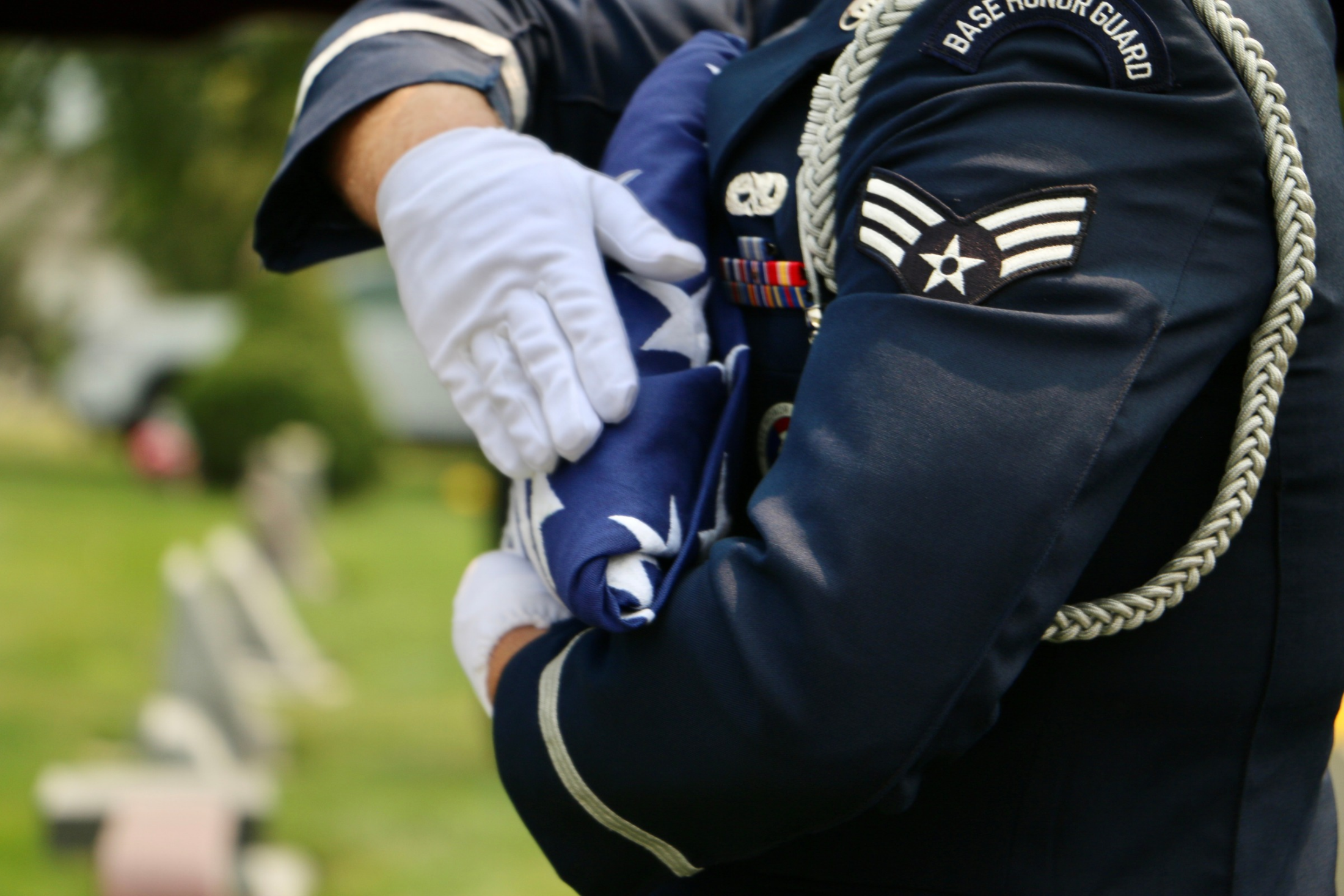
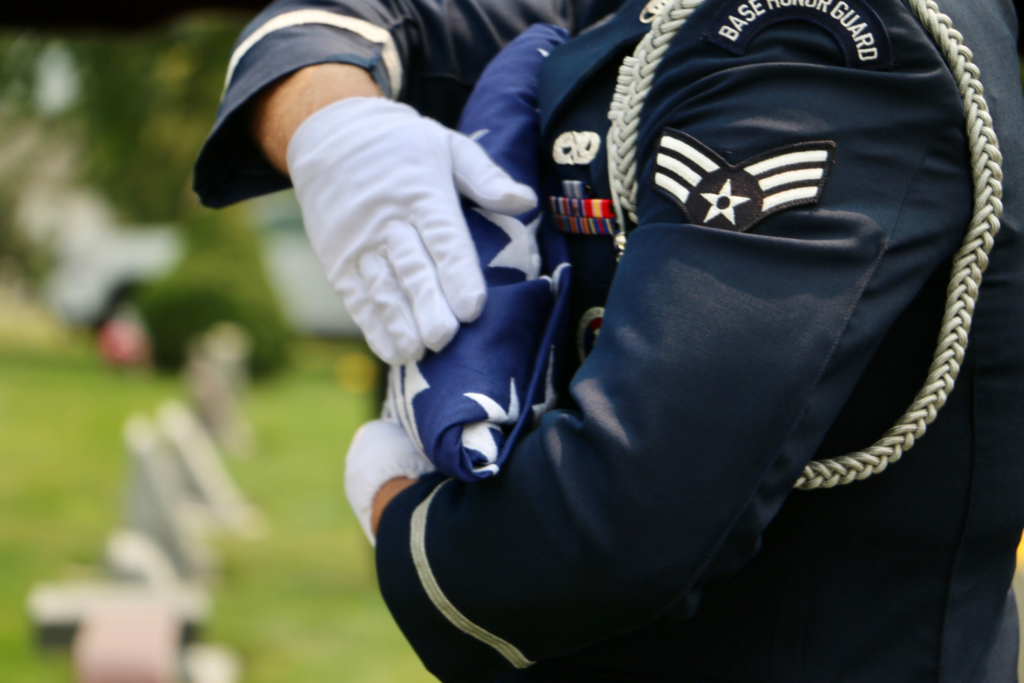
There is a moment at a veteran’s funeral when nearly everyone becomes still.
The conversation stops. The military detail takes its place. Taps begins, and a melody that lasts less than a minute suddenly carries the weight of decades of service, family memories, deployments, uniforms, sacrifice, and pride.
Then comes the flag.
It is folded carefully and presented to someone the veteran loved.
For families watching the ceremony for the first time, each movement can feel deeply significant without anyone having explained what is happening.
Military funeral honors follow established traditions designed to recognize honorable service to the United States. They can be provided for eligible veterans whether the funeral involves burial or cremation and whether the final resting place is a national cemetery or a private cemetery.
On the eve of Veterans Day, it is worth understanding what these traditions mean and how families can make sure an eligible veteran receives them.
Military Funeral Honors Are an Earned Recognition of Service
Military honors are not limited to veterans who died in combat.
Eligible veterans may receive funeral honors based on qualifying military service and discharge status. Active duty service members and certain members of the National Guard and Reserve may also qualify under federal rules.
The minimum ceremony established by federal law includes at least two uniformed members of the Armed Forces. At least one member must represent the branch in which the veteran served.
The core ceremony includes three things:
The playing of Taps.
The ceremonial folding of the United States flag.
The presentation of that flag to the next of kin or other appropriate recipient.
The Military OneSource guide to what families can expect during military funeral honors explains these elements and how additional honors may be included when personnel and resources are available.
What Does the Honor Guard Represent?
The uniformed military detail is one of the most visible parts of the ceremony.
Its presence represents the veteran’s branch of service and, more broadly, the nation recognizing the person’s military service one final time.
The required minimum detail consists of two service members, although some funerals include larger teams.
A larger detail may include pallbearers, a color guard, a firing party, a bugler, or additional service members depending on eligibility, the veteran’s military status, available personnel, and the type of honors authorized.
Veterans service organizations may also help augment military personnel in certain ceremonial roles.
The number of people present should not be confused with the importance of the honor.
A two person detail performing Taps and presenting the flag is still an official military funeral honors ceremony.
Why Is Taps Played?
Few pieces of music are as immediately recognizable as Taps.
The bugle call originated during the Civil War and was officially recognized by the Army in the nineteenth century. It later became a standard part of military funeral ceremonies.
Today, Taps serves as the musical farewell in military funeral honors.
When possible, it is played by a live bugler. If a live bugler is unavailable, the ceremony may use a ceremonial bugle or an approved high quality recording.
The absence of a live musician does not make the honors unofficial.
For a veteran’s family, Taps often becomes the emotional center of the ceremony because there are no lyrics and nothing that needs explaining.
The military detail stands in silence.
The family listens.
The notes themselves become the farewell.
The Flag Begins as a Symbol of the Veteran’s Service
For a traditional casketed funeral, the American flag may be draped over the closed casket.
The blue field, known as the union, is positioned at the head and over the veteran’s left shoulder.
The flag honors the person’s service to the country.
Families choosing cremation are not excluded from this tradition. Military funeral honors can also be performed when cremated remains are present. Depending on the ceremony, the flag may arrive folded and then be opened and held ceremonially over or near the urn before being folded again for presentation.
The form of disposition changes.
The recognition of service does not.
What Does the Folding of the Flag Mean?
After Taps, the flag is folded with deliberate and precise movements.
A properly proportioned burial flag is folded into a triangular shape until only the blue field and stars remain visible.
The triangular shape is traditionally associated with the tricorn hats worn during the American Revolution.
A properly folded flag involves 13 triangular folds, associated with the original 13 colonies.
Families may have seen lists assigning a separate religious, patriotic, or symbolic meaning to every individual fold. Various ceremonial readings exist, and families may encounter them through veterans organizations or other traditions.
Those additional readings should not be confused with the required federal military funeral honors ceremony itself.
The central official meaning is simpler.
The flag is being prepared for its final presentation as a lasting symbol of the veteran’s honorable service.
The Presentation of the Flag Is the Nation’s Thank You
Once the flag has been folded, a representative of the veteran’s branch presents it to the designated recipient.
This is usually the next of kin.
The service member faces the recipient, holds the folded flag with care, and presents it using prescribed language expressing gratitude on behalf of the United States, the veteran’s branch of service, and a grateful nation.
For many spouses, children, or parents, this becomes the object they keep for the rest of their lives.
The flag may eventually sit in a triangular display case beside military photographs, medals, ribbons, discharge papers, or other family keepsakes.
It began as part of the ceremony.
After the presentation, it belongs to the family as a permanent recognition of service.
Who Receives the Burial Flag?
The flag is ordinarily presented to the veteran’s next of kin according to established priority.
That often means a surviving spouse, followed by children, parents, siblings, or other relatives depending on the family situation.
If no next of kin is available, an appropriate friend or associate may sometimes receive the flag.
The VA generally provides one burial flag for an eligible veteran.
If there is any question about who should receive it, families should discuss that issue with the funeral director before the service rather than trying to resolve it while the ceremony is beginning.
What About the Rifle Volley?
A rifle volley is one of the most recognized military funeral traditions, but it is not guaranteed as part of the minimum honors provided to every veteran.
Depending on the veteran’s status, available resources, cemetery rules, and personnel, a firing party may perform three rifle volleys.
This is sometimes incorrectly called a “21 gun salute.”
The two ceremonies are different.
A traditional military funeral rifle volley involves members of a firing party firing rifles in three separate volleys. The total number of shots depends on the number of people in the firing party.
A 21 gun salute is a separate ceremonial honor traditionally performed with artillery and reserved for presidents, heads of state, and other designated occasions.
If a rifle volley is important to your family, ask about its availability when military honors are requested.
Are Pallbearers and a Color Guard Automatically Included?
No.
The required minimum military funeral honors do not automatically include a full complement of military pallbearers, color guard, firing party, caisson, or aircraft flyover.
Those elements may be provided depending on the veteran’s status and available military resources.
Some veterans service organizations also assist with firing parties, pallbearers, buglers, or color guards.
This is one reason families should discuss expectations early.
If someone remembers a military funeral with six uniformed pallbearers and assumes every veteran receives the same ceremony, disappointment can result.
The core honors are consistent.
Additional elements vary.
How Does a Family Request Military Funeral Honors?
Families should tell the funeral director about the veteran’s military service as early as possible.
The funeral director can help request honors from the appropriate military branch and coordinate the military detail with the cemetery, church, funeral home, or other service location.
The Department of Veterans Affairs explains through its official military funeral honors information for veterans and families that funeral directors or a family’s personal representative can request military honors. For services at VA national cemeteries, cemetery staff can also assist with coordination.
The VA recommends providing at least 48 to 72 hours of notice before the scheduled service whenever possible.
More notice is helpful because the service branch needs time to assign personnel and coordinate travel.
The DD-214 Is Usually the Document Families Need First
A veteran’s DD Form 214 is one of the most important documents to locate when arranging military honors.
The DD-214 documents the veteran’s military service and discharge status and is commonly used to establish eligibility.
Families should keep it somewhere safe and make sure at least one trusted person knows where it is.
If the DD-214 cannot be found, do not assume honors are impossible.
Military service records may be obtainable through federal record systems, and military funeral honors coordinators can sometimes assist when other identifying information is available.
Finding the document before a death simply makes the process much easier.
Military Honors Can Be Held at More Than a National Cemetery
Another common misconception is that a veteran must be buried in a national cemetery to receive military funeral honors.
That is not the case.
Eligible veterans may receive honors at private cemeteries, Catholic cemeteries, other religious cemeteries, funeral homes, churches, and other appropriate locations.
Burial in a VA national cemetery provides additional federal cemetery benefits, but military funeral honors themselves are not limited to national cemetery burials.
A veteran who chose a family plot in Northeast Philadelphia or Bucks County can still be recognized with military honors if eligible.
Cremation Does Not Change Eligibility for Honors
A veteran who chose cremation may receive the same core military funeral honors as a veteran whose casket is buried.
Taps may be played.
The military detail may attend.
The American flag may be folded and presented.
The honors may take place during a funeral, memorial service, graveside ceremony, columbarium committal, or another appropriate gathering.
Families should tell the funeral director where and when they would like the military portion of the service to occur so it can be coordinated properly.
How Fluehr Can Help With Military Funeral Honors
Families should not have to become military protocol experts during funeral week.
Once the veteran’s service information is provided, the funeral director can help determine what documentation is needed, request the military honors detail, coordinate timing with the service branch and cemetery, and help secure the burial flag.
John F. Fluehr & Sons includes veteran funeral services and military honors coordination for Northeast Philadelphia families among the funeral services available from its Cottman Avenue location.
The goal is not to add ceremony simply for appearance.
It is to make sure a veteran receives the recognition earned through service and that the family understands what will happen before the ceremony begins.
Planning Ahead Makes Military Honors Easier to Arrange
Veterans can make things much easier for their families by organizing military information in advance.
Keep the DD-214 accessible.
Record the branch of service.
Record rank, service dates, and important assignments or conflicts if relevant.
Tell the family whether national cemetery burial is preferred.
Identify any existing cemetery property.
Make clear that military honors are desired.
Keep medals, photographs, citations, and other military materials together if the family may want to display them during the funeral.
Fluehr’s planning and family resource center for Northeast Philadelphia gives families a place to begin organizing funeral wishes and the practical information that may be needed later.
A few decisions made in advance can prevent adult children from asking, “Would Dad have wanted military honors?” when the answer could have been written down years earlier.
Every Movement Is Meant to Say Thank You
Military funeral honors are deliberately simple.
Uniformed service members arrive.
Taps is played.
The flag is folded.
A representative of the veteran’s branch places it into the hands of someone who loved them.
Additional honors may surround those moments, but the heart of the ceremony remains the same.
The nation is recognizing that this person served.
On Veterans Day, communities thank living veterans for that service.
At a military funeral, the same gratitude is expressed one final time after a veteran has died.
For the family receiving the folded flag, that ceremony often lasts only a few minutes.
The meaning of it lasts much longer.
The team at John F. Fluehr & Sons is here for your whole family and includes its youngest members. Call us at (215) 624-5150.