The first days of November can look very different from one Northeast Philadelphia household to the next.
One family goes to Mass on November 1. Another writes the names of parents and grandparents in a parish Book of the Dead for prayers throughout November. In another home, photographs, candles, flowers, food, and treasured objects are arranged on an ofrenda for Día de los Muertos.
An Orthodox family may be remembering its dead too, but according to a different church calendar and a different set of memorial traditions.
These customs overlap in one important way: none of them treats remembering the dead as something families simply finish after a funeral.
Memory continues.
It continues in prayer, at graves, around family tables, through photographs, in church, and in the stories younger generations hear about relatives they may never have met.
All Saints Day, All Souls Day, and Día de los Muertos are not three names for the same observance. Orthodox Christian practices should not be folded into the Western Catholic calendar either. Each tradition deserves to be understood on its own terms.
What they share is the conviction that those who died still matter to the living.
All Saints Day Comes First on November 1
In the Roman Catholic Church, November 1 is the Solemnity of All Saints.
The day honors the saints, both those formally recognized by the Church and the countless holy people known only to God.
This is different from praying specifically for deceased relatives.
All Saints celebrates those believed to be with God. It places familiar saints such as Peter, Paul, Francis, Teresa, Patrick, Joseph, and countless others within a much larger communion that includes people whose names never appeared on a church calendar.
For a Catholic family, the day is therefore rooted in hope rather than simply remembrance.
The emphasis is on holiness, eternal life, and the belief that death does not sever the communion of the Church.
In heavily Catholic neighborhoods like Mayfair, Tacony, Holmesburg, Rhawnhurst, Fox Chase, and parts of the Far Northeast, generations grew up knowing November 1 as part of the church calendar even when family traditions around the day varied considerably.
All Souls Day Turns the Attention Toward the Departed
November 2 has a different purpose.
All Souls Day, formally the Commemoration of All the Faithful Departed, is a day of prayer for those who have died.
This is where family remembrance becomes particularly visible.
Parishes may celebrate special Masses. Families submit names for remembrance. A Book of the Dead may be placed in church during November so parishioners can enter the names of relatives and friends who died.
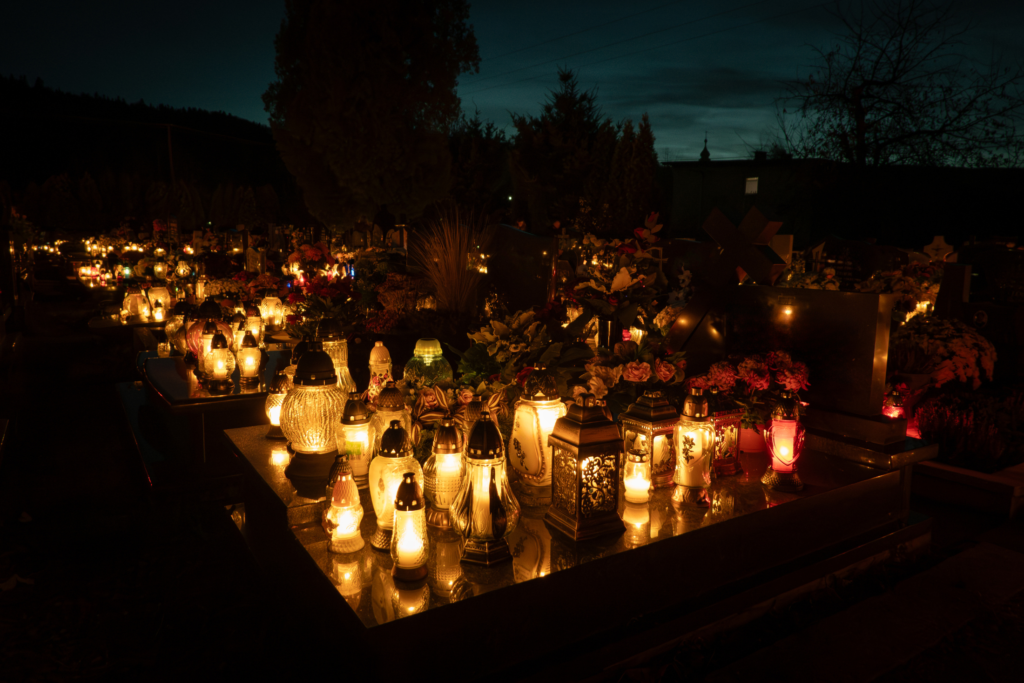
People visit cemeteries, bring flowers, clean family graves, and pray for parents, grandparents, spouses, children, siblings, and friends.
The difference between November 1 and November 2 is worth keeping clear.
All Saints honors the saints.
All Souls remembers and prays for the faithful departed.
The days sit beside one another on the calendar, but they serve different purposes.
Why November Became a Month of Remembrance
For many Catholic families, remembering the dead is not confined to November 2.
November itself has traditionally become a month when the departed receive particular attention.
Names are remembered at Mass. Families visit cemeteries. Parish communities remember members who died during the previous year. Old prayer cards are taken from drawers. People think again about parents and grandparents whose anniversaries might have passed quietly during the rest of the year.
That rhythm reflects an important part of Catholic mourning.
A funeral is not the end of prayer for a person who died.
Remembrance continues.
For families who recently experienced a loss, that can make the first November after a death especially emotional. A name that was once part of ordinary conversation now appears in a memorial book or is spoken during a parish service.
For families whose loss happened decades ago, the experience may feel gentler but still significant.
Grandmom has been gone twenty years.
Her name is still written down.
Día de los Muertos Is Not Simply Another Name for All Souls Day
The calendar creates understandable confusion.
Día de los Muertos is observed around November 1 and 2, and All Souls Day falls on November 2. Both involve remembering people who died. Both may include cemetery visits, prayer, flowers, candles, and family gatherings.
But they are not identical traditions.
U.S. Catholic’s explanation of the difference between Día de los Muertos and All Souls Day describes two traditions that meet on the calendar while coming from different cultural histories.
All Souls developed within European Catholic Christianity as a day of prayer for the faithful departed.
Día de los Muertos developed through Mexican traditions shaped by Indigenous understandings of death alongside centuries of Catholic influence.
For many Mexican and Mexican American families, Día de los Muertos is both deeply personal and unmistakably communal.
The people who died are remembered not only with sorrow but through the things that made them recognizable in life.
An Ofrenda Is About a Person, Not About Decoration
The colorful visual traditions of Día de los Muertos have become widely recognizable in the United States.
That familiarity can sometimes cause the meaning behind them to disappear.
An ofrenda is not simply seasonal décor.
It is a place of remembrance.
Families may include photographs of relatives who died, candles, flowers, religious images, favorite foods, drinks, personal objects, papel picado, and other meaningful items.
The details tell stories.
A cup of coffee might recall the way a grandfather began every morning.
A favorite candy might belong to a child who died.
A photograph might show a grandmother young enough that grandchildren barely recognize her.
A plate of familiar food can carry the smell and memory of family gatherings that happened decades earlier.
The Smithsonian American Art Museum’s history of Día de los Muertos traditions in the United States traces both the Mexican and Indigenous roots of the observance and the ways Mexican American and Chicano communities have carried and transformed the tradition in the United States.
That history matters because Día de los Muertos should not be reduced to painted skulls or a colorful version of Halloween.
At its center are people.
The Cemetery Can Become Part of the Family Gathering
Día de los Muertos also changes the way some families experience a cemetery.
A graveside does not have to be visited only in silence.
Families may bring flowers, food, stories, music, and conversation. The visit can carry joy alongside grief.
That does not mean the death no longer hurts.
It means sorrow and affection are permitted to occupy the same place.
A cemetery visit may become an opportunity for grandchildren to hear who is buried there, how their grandparents met, why an uncle was funny, or what a great grandmother cooked every Sunday.
The grave becomes part of family history rather than a place disconnected from everyday life.
Latino Families Are Not One Tradition
Northeast Philadelphia’s Latino community includes families with roots in Puerto Rico, the Dominican Republic, Mexico, Colombia, Central America, South America, and many other places.
Día de los Muertos should not be presented as though every Latino family observes it.
It is particularly associated with Mexico and Mexican communities, although celebrations have spread and developed in other parts of Latin America and the United States.
Puerto Rican, Dominican, Colombian, and other Catholic families may observe All Saints and All Souls through Mass, cemetery visits, prayer, home customs, or not at all.
Two families speaking the same language may approach death and remembrance completely differently.
That is why good funeral service begins by asking rather than assuming.
Orthodox Christians Remember the Dead on a Different Calendar
Northeast Philadelphia is also home to Ukrainian, Russian, and other Eastern Orthodox families whose traditions of remembrance should not be treated as if they simply follow the Roman Catholic November calendar.
They generally do not.
In Eastern Orthodox Christianity, All Saints is traditionally observed on the first Sunday after Pentecost rather than November 1.
Orthodox churches also designate several Memorial Saturdays, sometimes called Soul Saturdays, specifically for commemoration of the departed.
During these observances, the Divine Liturgy and memorial services may include prayers for those who died. Families submit names for remembrance, and traditions may include kollyva, a dish of boiled wheat associated with resurrection and the departed.
Another important Orthodox tradition occurs after Pascha, when families in many communities visit graves, pray for those who died, and connect the hope of the Resurrection with remembrance of loved ones.
The exact customs vary across Orthodox jurisdictions, ethnic traditions, parishes, and families.
The important point is simple.
Orthodox Christians absolutely have rich traditions for remembering the dead, but November 1 and 2 do not hold the same universal liturgical role that they do in the Roman Catholic calendar.
Why That Distinction Matters in Northeast Philadelphia
A funeral home serving Northeast Philadelphia encounters families whose traditions may look similar from the outside while carrying very different meanings inside the family.
A Catholic family may request a Funeral Mass and later return to the cemetery around All Souls Day.
An Orthodox family may request a Panikhida and observe memorial days according to its parish calendar.
A Mexican American family may celebrate Día de los Muertos with an ofrenda while also attending Catholic Mass.
Another Latino Catholic family may observe All Souls without any Día de los Muertos tradition at all.
None of those families should have to fit into somebody else’s template.
John F. Fluehr & Sons has served Philadelphia since 1898, and its history of serving Northeast Philadelphia families of different faiths and cultural backgrounds reflects how much the community itself has changed across generations.
Serving a diverse neighborhood well means understanding that faith and culture are not decorations added to a funeral.
For many families, they determine what the funeral means.
Three Traditions, Three Different Emphases
One useful way to understand these observances is to look at what each emphasizes.
All Saints Day celebrates holiness and the communion of saints.
All Souls Day emphasizes prayer for those who have died.
Día de los Muertos brings departed family members into active remembrance through home altars, cemetery visits, food, objects, photographs, and family traditions.
Orthodox remembrance follows another calendar but similarly keeps prayer for the departed woven into the continuing life of the Church.
There is overlap.
There are also differences that should remain differences.
Respect does not require combining traditions into one general celebration of remembrance.
It requires learning enough to know why each family does what it does.
Children Learn Family History Through These Traditions
These observances also do something important for younger generations.
They make family history visible.
A child may never have met the great grandfather whose name is entered in the Book of the Dead.
A teenager may recognize a woman in an ofrenda photograph only because an aunt has told the same story about her every November.
A young Orthodox child may hear a grandparent’s name prayed during a memorial service and begin to understand why the family returns to the cemetery.
Without these moments, family history can disappear quickly.
A name becomes a photograph.
The photograph goes into a drawer.
The people who remember the story eventually die too.
Ritual interrupts that disappearance.
Visiting a Grave Is Part of the Story Too
For all the theological and cultural differences among these traditions, the cemetery remains important to many families.
A grave gives remembrance a physical location.
People can clean the stone.
Bring flowers.
Say a prayer.
Leave a small memorial where cemetery rules permit.
Tell a child whose name is carved there.
Stand quietly.
Or simply stop by for ten minutes because November arrived and it felt like the right thing to do.
That does not mean every family needs a cemetery tradition. Cremation, geographic distance, family preference, and different cultural practices shape remembrance in many ways.
It does mean that returning to a resting place can remain meaningful long after the funeral itself.
Remembering Someone Does Not Require Choosing Between Sadness and Joy
One reason these traditions endure is that they make room for more than one emotion.
A Catholic may pray solemnly at Mass and laugh over a story about Dad later that afternoon.
A Día de los Muertos ofrenda may include grief beside bright flowers, favorite food, music, and humor.
An Orthodox memorial service may be solemn while the family gathering afterward is full of familiar stories.
Grief does not remain one emotion forever.
Neither does remembrance.
Someone can be missed terribly and remembered joyfully at the same time.
Families Can Preserve These Traditions Before They Are Needed
One of the easiest things to lose after a death is knowledge of family customs.
If your parents or grandparents have particular wishes, ask about them now.
Which parish should be called?
Which priest or church community knows the family?
Is there an existing cemetery plot?
Are names traditionally submitted for memorial services?
Does the family build an ofrenda?
Are there photographs, icons, prayer books, recipes, cemetery customs, or religious objects that should stay with the next generation?
These questions are not only funeral planning questions.
They are family history questions.
Families beginning those conversations can use John F. Fluehr & Sons’ planning and grief resources for Northeast Philadelphia families to understand practical decisions before or after a death.
November Reminds Us That Memory Has Many Languages
One family lights a candle at Mass.
Another leaves marigolds beside a photograph.
Another brings names to church for a memorial service on a completely different date.
Another simply visits the cemetery and tells the grandchildren who is buried there.
The customs are not interchangeable, and they do not need to be.
The important thing is that the person is still named.
The story is still told.
The prayer is still offered.
The photograph is still placed where someone younger will ask, “Who is that?”
That question is how memory moves forward.
All Saints, All Souls, Día de los Muertos, and Orthodox memorial traditions approach remembrance from different histories and different beliefs. Taken seriously on their own terms, each shows something important about the families who practice them.
People do not stop belonging to a family simply because they died.
The ways we remember them are part of how families carry them forward.
The team at John F. Fluehr & Sons is here for your whole family and includes its youngest members. Call us at (215) 624-5150.