Twenty five years have passed, yet September 11 still feels different from almost every other date on the calendar.
In Northeast Philadelphia, remembrance rarely depends on one large ceremony. It happens in smaller places that feel close to home. An American flag rises outside a firehouse. Police officers stand beside neighbors for a moment of silence. A bugler plays Taps. Parishioners gather for prayer. Families tell younger children why the date matters. Retired first responders remember where they were when the news came. Someone sees a fire engine pass and thinks again about the people who ran toward danger while others were trying to escape.
September 11, 2026 marks the 25th anniversary of the terrorist attacks on the World Trade Center, the Pentagon, and United Airlines Flight 93. For people old enough to remember the day, a quarter century can seem impossible. For an entire younger generation, September 11 is history rather than personal memory.
That makes local remembrance more important, not less.
Twenty Five Years Later, the Meaning of Remembrance Is Changing
Adults who were children in 2001 are now parents. Teenagers learning about September 11 in school were born years after the attacks. Some of the first responders who once stood at community ceremonies in uniform are now retired. Families who lost loved ones have carried those absences through twenty five birthdays, holidays, anniversaries, graduations, weddings, and ordinary days.
The responsibility to remember is gradually moving from firsthand witnesses to the generations who came after them.
The National September 11 Memorial & Museum’s work of remembrance and education reflects that transition. For the 25th anniversary, family members will once again gather at the Memorial plaza in New York to read aloud the names of those killed in the 2001 attacks and the 1993 World Trade Center bombing. Moments of silence mark the events of the morning and honor those whose lives were later lost to illnesses connected with September 11.
The national ceremony gives the country a shared place to remember. Neighborhood traditions give remembrance a local voice.
In Northeast Philadelphia, Remembrance Often Starts With First Responders
The connection between September 11 and first responders has never faded.
Firefighters, police officers, emergency medical personnel, military veterans, and their families remain central to many local ceremonies because service and sacrifice are inseparable from the story of that day.
Firehouses are particularly meaningful places to gather.
On September 11, 2001, 343 members of the New York City Fire Department were killed. Their deaths changed the way an entire generation viewed firefighters. Images of firefighters carrying equipment toward the burning towers became lasting symbols of courage and duty.
In Northeast Philadelphia, the simple sight of firefighters standing beside an engine during a remembrance ceremony carries that history without requiring a long explanation.
The traditions are often understated. A flag raising. A bell. Taps. A prayer. A wreath. A moment when people simply stand together.
Those gestures fit the Northeast particularly well. This is a part of Philadelphia where people often know their local firehouse, see the same officers around the neighborhood, recognize the people working community events, and understand public service on a personal level.
A Tradition Seen at the Philadelphia Protestant Home
One example of how Northeast Philadelphia keeps the memory alive comes from the Philadelphia Protestant Home on Martins Mill Road.
Over the years, its September 11 observances have brought residents together with local firefighters, police officers, emergency medical personnel, veterans, clergy, elected officials, and neighbors.
In 2021, during the 20th anniversary, the community gathered with members of Engine 64, Burholme Emergency Medical Services and the Cheltenham Fire Company. The American flag was raised, Taps was played, veterans were recognized, and clergy offered prayer.
The tradition continued. In 2024, the remembrance again included a flag raising, Taps, Engine 64 and a community relations officer from the 2nd Police District. In 2025, the home held another annual ceremony with a moment of silence, flag observance, Engine 64, VMSC Emergency Medical Services and the 2nd District represented.
Coverage in the Northeast Times and its reporting on local community remembrance has preserved many of these moments over the years. That local record matters because it shows remembrance not as one isolated anniversary, but as a tradition carried forward by the same neighborhoods and institutions.
The 2nd, 7th, 8th and 15th Police Districts Are Part of the Northeast’s Community Fabric
When Northeast Philadelphia talks about community, the local police districts are often part of the conversation.
The 2nd, 7th, 8th and 15th districts cover large parts of the Northeast, stretching across neighborhoods that include Rhawnhurst, Bustleton, Somerton, Mayfair, Tacony, Holmesburg, Torresdale and surrounding areas.
Each district has its own relationship with residents, civic groups, schools, houses of worship and neighborhood organizations. Officers appear at community meetings, memorial events, National Night Out gatherings, school programs, veterans events and ceremonies recognizing public service.
September 11 gives that presence a different meaning.
Police officers were among the people who responded when New York was attacked. Members of the Port Authority Police Department and New York Police Department died while helping evacuate buildings and responding to the disaster. Across the country, police departments have carried those names and that service into their own traditions of remembrance.
Here in the Northeast, seeing local officers stand alongside firefighters, clergy, veterans and residents brings the national story closer to home.
It reminds us that public service is not abstract. It has names, families, shifts, stations and people who answer when someone calls for help.
Parishes and Houses of Worship Give the Day Another Kind of Space
Northeast Philadelphia has always been shaped by faith communities.
Catholic parishes, Protestant churches, synagogues and other houses of worship have long served as places where people gather during national tragedy as well as personal loss.
September 11 remembrance naturally found a home there.
Memorial Masses, prayer services, candle lightings, Scripture readings and quiet moments of reflection give families a place to process something larger than themselves. Some people attend because they lost someone. Others attend because they served. Some remember a colleague, firefighter, police officer or friend. Others simply feel that the day should not pass like any other.
In past Northeast ceremonies, clergy from several traditions have participated together. At St. James Lutheran Church during the 20th anniversary observance, religious leaders from local Christian communities joined residents, public officials and neighbors. Candles were lit in remembrance, hymns were sung and reflections focused on loss, sacrifice and the obligation to care for one another.
That kind of gathering reflects something important about September 11. The day belongs to no single institution or denomination.
It belongs to memory.
For First Responders, September 11 Is Personal
For many firefighters, police officers and emergency medical workers, September 11 has always carried a professional dimension that civilians experience differently.
They know what it means to respond without knowing what waits at the other end of the call.
They understand the instinct to move toward an emergency. They understand chain of command, teamwork, equipment, training and the trust required between people working in dangerous circumstances.
The loss of hundreds of firefighters and law enforcement officers on September 11 therefore reaches beyond New York. Firehouses and police departments across the country felt those deaths as losses within their own professions.
That bond helps explain why firehouse ceremonies remain such an enduring part of September 11 remembrance.
A bell rung in Northeast Philadelphia does not need to recreate what happened in New York. Its meaning comes from recognizing the people who answered their call and did not return home.
Remembering September 11 With Children Who Were Not There
One of the biggest changes on the 25th anniversary is generational.
Children and teenagers today have no personal memory of September 11. Even many young adults were born after 2001.
Parents and grandparents therefore face a question previous generations did not: how do you explain a day that changed the country without frightening young people or reducing it to a textbook paragraph?
Age matters.
Younger children do not need graphic details. They benefit from simple explanations about what happened, why people remember the victims, and why firefighters, police officers and ordinary citizens are honored for helping others.
Older children and teenagers are able to understand more history. They might ask about terrorism, the wars that followed, airport security, first responder illnesses or why adults who remember the day still become emotional.
Those questions deserve honest answers.
Families speaking with young people about death, tragedy and remembrance may also find value in guidance for helping children and teens understand grief and loss. Children often move between difficult emotions and ordinary life much faster than adults do, and giving them permission to ask questions helps them make sense of what they hear.
Remember the Lives, Not Only the Images
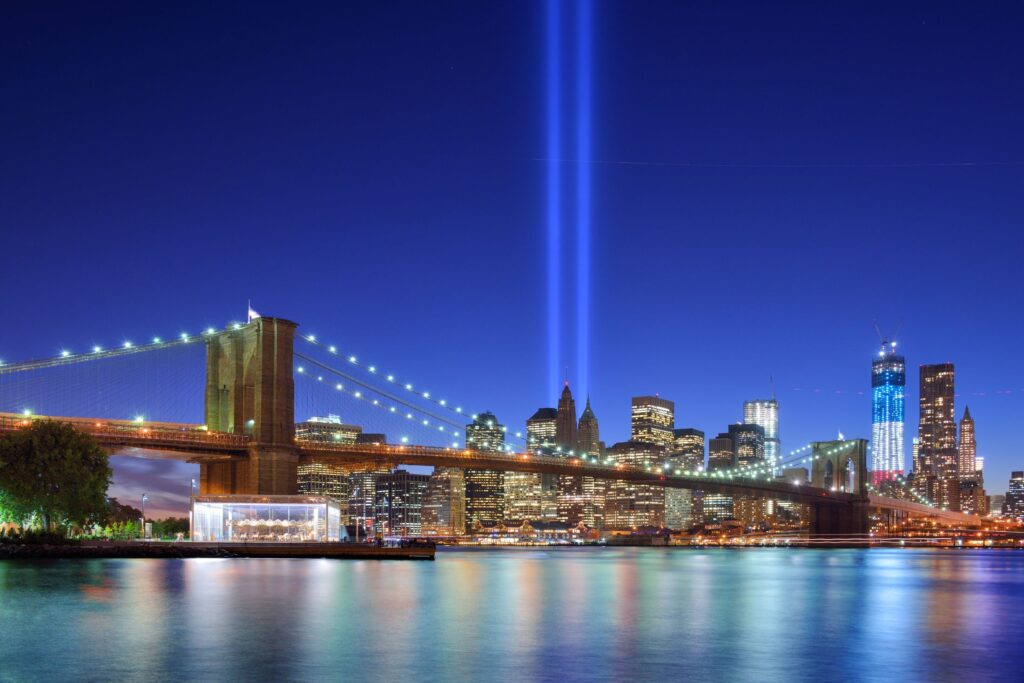
September 11 is associated with images nearly everyone recognizes. Smoke pouring from the towers. Firefighters covered in dust. People running through Lower Manhattan. The Pentagon burning. The field near Shanksville, Pennsylvania. Two beams of light rising into the New York sky.
But remembrance becomes more meaningful when the people behind those images remain visible.
Nearly 3,000 people were killed on September 11, 2001. They were parents, spouses, children, siblings, friends and coworkers. They had morning routines. They had dinner plans. They had people expecting them home.
The first responders who died were not symbols when they left for work that morning. They were people doing their jobs.
That is why reading the names remains such a central part of the national commemoration. A number describes the scale of tragedy. A name reminds us of a life.
The Day Also Belongs to Those Who Came Home Changed
September 11 remembrance has expanded over the years to include another group: people who survived the attacks and those who worked for months in rescue and recovery.
Many developed serious illnesses connected with exposure to toxins at Ground Zero. Some have died years or decades after the attacks.
For families, the timeline of September 11 therefore did not end when the fires went out.
There are widows and widowers who experienced another loss years later. Children grew up watching a parent’s health decline. First responder families lived with medical appointments, uncertainty and memories that never fit neatly into an anniversary ceremony.
Understanding this longer story makes the phrase “never forget” broader. It means remembering the people killed that morning and continuing to recognize those who carried its consequences afterward.
Grief Twenty Five Years Later Is Still Grief
Anniversaries have a way of bringing old grief closer.
A family might function well throughout the year and still find September difficult. A retired firefighter might hear Taps and return instantly to memories of 2001. Someone who lost a childhood friend might feel the absence differently at 70 than they did at 45.
Time changes grief. It does not erase the relationship behind it.
Fluehr’s resource for supporting yourself and others through grief reflects an important idea for anniversaries like September 11: people respond to loss differently, and difficult dates often call for patience, connection, memory and care rather than expectations about how someone should feel after a certain number of years.
For some people, attending a ceremony helps. Others prefer church. Some visit a cemetery. Some watch the national remembrance privately. Some tell stories. Others need quiet.
There is room for all of those forms of remembrance.
What September 11 Remembrance Looks Like in a Neighborhood
A neighborhood remembrance does not need thousands of people.
Sometimes it is twenty residents standing near a flagpole.
It is a firefighter straightening the flag before a ceremony.
It is an officer removing a hat for a moment of silence.
It is Taps carrying across a parking lot.
It is a priest remembering the dead during Mass.
It is a teacher explaining why September 11 appears on the classroom calendar.
It is a parent telling a teenager, “I remember exactly where I was.”
It is someone thanking a first responder without making a spectacle of it.
These small acts are how collective memory survives.
The Northeast Remembers by Showing Up
Northeast Philadelphia has always been a collection of neighborhoods more than one single identity. Mayfair feels different from Somerton. Tacony has a different history from Fox Chase. Rhawnhurst, Holmesburg, Bustleton, Torresdale and Lawncrest each have their own institutions and traditions.
Yet September 11 creates common ground.
Firefighters stand with police officers. Veterans stand with residents. Clergy stand with families. Older adults who remember the day stand beside children learning about it for the first time.
Twenty five years later, perhaps that is the most important part of remembrance.
We cannot preserve September 11 by repeating only the facts. We preserve its meaning by remembering individual lives, teaching younger generations, honoring service, making room for grief and continuing to gather.
The flags outside Northeast firehouses will eventually come down after the ceremony. The prayers will end. Police officers will return to their districts. Firefighters will go back on duty. Families will drive home.
But the act of stopping together matters.
It says that twenty five years is not too long to remember.