If your family is planning a Catholic funeral and considering cremation, the first question is often simple: Can a Catholic be cremated? The answer is yes, but with conditions that affect how the funeral Mass, the urn, and the committal are arranged. The Church permits cremation, yet it still prefers that the body be present for the funeral Mass and requires that cremated remains be interred rather than scattered or kept at home. Those requirements shape practical decisions, not just the question of whether cremation is allowed.
This guide explains the rules in plain language. It begins with the short answer and then traces where the rules come from, from 1963 to the 2016 instruction Ad resurgendum cum Christo. It covers the conditions attached to cremation, why the Church still prefers traditional burial, and the two common options: the body present at Mass followed by cremation, or cremation first with the urn at Mass. You will also learn what is allowed for the urn and ashes, what “interred” means for committal, how planning works in Philadelphia, questions to ask your parish, pastoral edge cases, how to work with a funeral home, and what this means for your family.
Can a Catholic Be Cremated? The Short Answer
Yes, with conditions. The 1963 Instruction Piam et Constantem established that cremation is not “opposed per se to the Christian religion.” That permission was later written into the 1983 Code of Canon Law and the 1990 Code of Canons of the Oriental Churches, making it settled law.
Today the governing document is Ad resurgendum cum Christo (“To Rise With Christ”), issued October 25, 2016, by the Congregation for the Doctrine of the Faith and approved by Pope Francis. It “insistently recommends” burial in cemeteries or other sacred places, calling it the most fitting expression of faith in the resurrection.
In the United States, nothing changed in 2016: the USCCB Secretariat of Divine Worship confirmed Catholics may have a funeral Mass with cremated remains present. For families, the question is not permission but planning, including how cremation and traditional burial shape the vigil, the Mass, the urn, and the committal.
Where the Rules Come From: 1963 to the 2016 Instruction
The 1963 Instruction Piam et Constantem reversed denying funeral rites: sacraments and a Catholic funeral should not be refused to someone requesting cremation. Motive, not method, was the test. Rites could be denied only when cremation was chosen from a denial of Christian dogmas, animosity toward a secret society, or hatred of the Catholic religion and the Church.
That permission, incorporated into the 1983 Code of Canon Law, now governs both Latin and Eastern churches. In 2016, Ad resurgendum cum Christo noted cremation “has notably increased in many countries” and clarified the required treatment of ashes; it clarified rather than restricted, so a funeral Mass with the urn present has been permissible in U.S. parishes for years. In 2023, the USCCB Committee on Doctrine tightened rules, requiring cremated remains be kept intact.
Families can review direct cremation in Philadelphia, which explains the path’s inclusions and exclusions.
The Conditions That Come With Permission
Ashes must be interred: in a grave, a columbarium niche, or a mausoleum crypt. Scattering, keeping the urn at home indefinitely, and dividing it among relatives are not allowed. The 2023 USCCB document requires remains stay intact, forbidding combining ashes with another person’s or placing them in jewelry. It also rules out alkaline hydrolysis and human composting as failing reverential treatment.
Because these conditions determine the timeline and the final resting place, families should settle them before the funeral date is set, reviewing Cremation vs. Traditional Burial: The Main Difference when weighing options.
Why the Church Still Prefers Traditional Catholic Burial
Ad resurgendum cum Christo calls burial “above all the most fitting way to express faith and hope in the resurrection,” a preference standing even though cremation is permitted. It treats the body as a temple of the Holy Spirit awaiting resurrection, not remains to be disposed of. Traditional Catholic burial usually means a vigil, a requiem Mass with the body present, a procession, and a committal at the grave.
That choice does not rule out cremation; it means choosing what the Church recommends. When cremation is chosen, families mirror burial’s structure: prayers after death, a vigil, a funeral liturgy, and a committal of the ashes. Precedent shows both carry full solemnity: in 2011, Bishop Michael Evans of East Anglia was cremated after a traditional funeral Mass, his ashes interred at St John the Baptist Cathedral in Norwich. Families weighing either path can start by choosing a funeral home in Northeast Philadelphia.
Option One: The Body Is Present at the Funeral Mass, Then Cremated
For families who choose cremation, the Church’s preferred arrangement keeps the body present through the rites. The sequence runs: prayers after death, a vigil or wake with the casket present, the funeral Mass, a committal at the cemetery, and cremation afterward. The casket, pallbearers, and procession remain part of the rite, so the funeral still feels like a traditional Catholic burial. This is also the only option that preserves an open-casket visitation or viewing.
Some dioceses and parishes permit cremation after the Mass with a second committal of the ashes later; confirm the order with your parish before printing anything.
Because this adds a step, ask your funeral director to coordinate the crematory, the cemetery, and the priest on a single timeline.
Option Two: Cremation First, With the Urn at the Funeral Mass
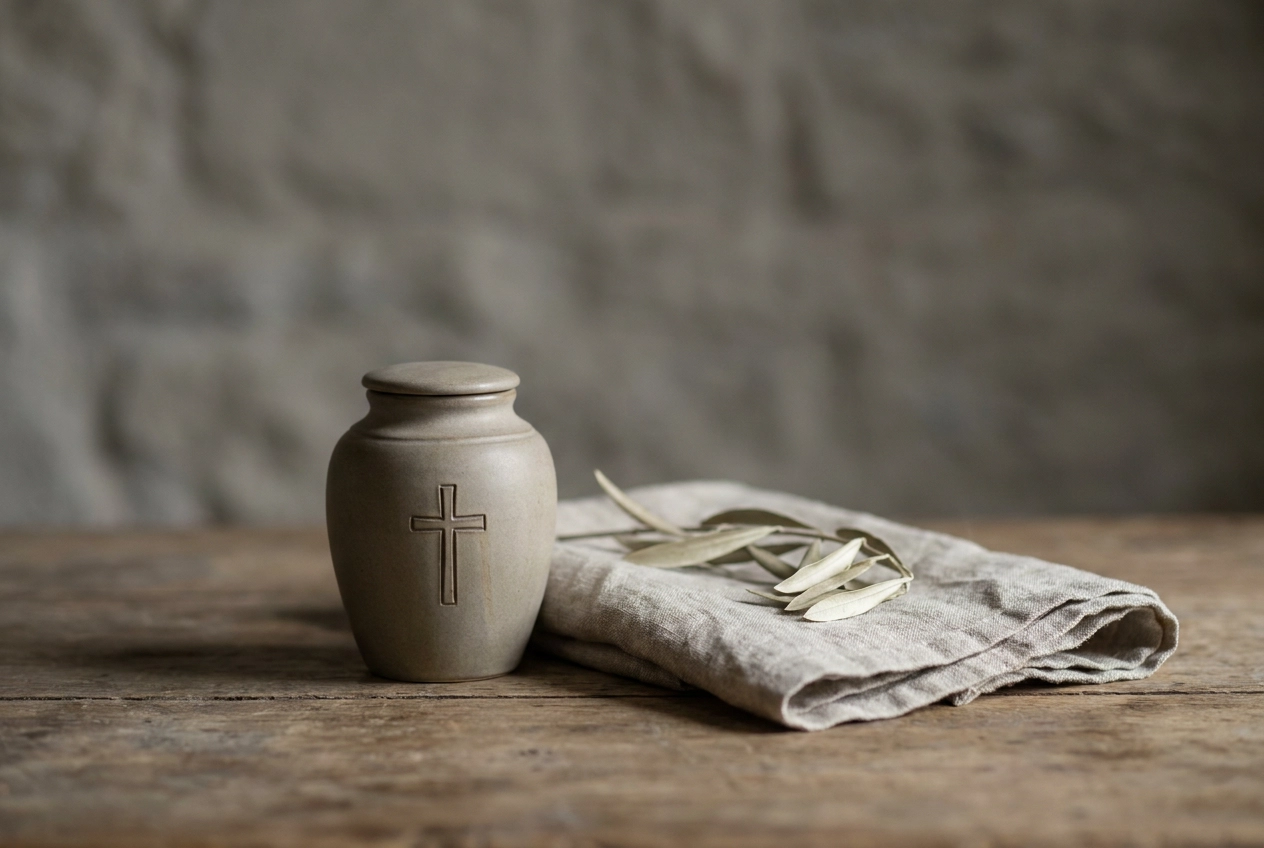
When families instead choose cremation first, the rites change but the reverence does not. The urn is treated like a casket: carried into church, placed on a suitable stand or table near the altar, and may be incensed. A pall may cover the urn, but practice varies by parish, so ask the priest or liturgist. Eulogy permission is likewise a parish decision, not a cremation rule, so raise it early.
Timing is the constraint: cremation must be completed before the Mass, compressing the planning window and requiring prompt authorization and coordination with the crematory. This option suits body donation to science, out-of-state burial, or a single service with the urn present. It does not allow open casket, presentation, and the final viewing.
The Urn and the Ashes: What Is Allowed and What Is Not
Once the Mass concludes, the ashes themselves follow clear rules.
Permitted, because each counts as interment: a dignified urn in a columbarium niche, a grave with an urn vault, or a mausoleum crypt.
Not permitted: scattering ashes at sea, in a garden, or at a favorite place; keeping the urn permanently at home; dividing ashes among siblings; or placing them in jewelry of any kind. The 2023 USCCB document prohibits placing remains in jewelry of any kind, since dividing or wearing remains contradicts the requirement that they stay intact. Ashes are interred whole in a single urn; the December 2023 Vatican clarification allows a family to request that a small portion be kept in a sacred place of significance to the deceased, not at home.
To honor a hobby or special place, choose a memorial marker, an engraved bench, or a memorial garden at a Catholic cemetery.
If ashes are already kept at home, a priest can advise on a later interment. The Church’s approach here is pastoral, not punitive.
Committal and Interment: What “Interred” Means in Practice
Many Catholic cemeteries maintain a dedicated section, columbarium wall, or cremation garden for urns, keeping the remains in sacred ground. The rite of committal may be celebrated at the graveside, at the niche, or in a crematorium chapel, depending on what the parish and cemetery allow. Urn vaults and niche covers protect the remains and give the family a permanent place to visit on anniversaries and holy days.
Ask the cemetery three questions: Is an urn vault required? What inscriptions are permitted? Can one niche hold two urns for a couple? Pre-planning the interment site removes a difficult decision from the days immediately following a death, when families are least able to compare options.
Cremation and Catholic Funeral Planning in Philadelphia
With interment settled, the funeral home takes over. Federal law prohibits funeral providers from requiring the purchase of a casket as a condition of other services, but each cemetery sets its own rules on urn vaults, niche sizes, and opening and closing fees, so confirm them early.
The funeral home coordinates the cremation authorization, the death certificate, the crematory, and the cemetery, which matters most when the urn must be ready before Mass.
John F. Fluehr & Sons, family-owned and serving Northeast Philadelphia since 1898, arranges a Mass with the body or the urn present and handles transportation to a Catholic cemetery. Request one plan covering vigil, Mass, cremation, urn, and committal. If your family is still weighing burial against cremation, ask which services allow either choice without restarting. Review how to read a funeral home general price list first. A director familiar with Philadelphia-area Catholic parishes will know which cemeteries accept urns.
Questions to Ask Your Parish Before You Plan
Your funeral director knows cemetery logistics; parish practice governs the liturgy. Ask:
- Does the parish allow a funeral Mass with cremated remains present, and where should the urn be placed in the church?
- May the vigil or wake be held with the urn, and can it take place in church or only at the funeral home?
- Is a eulogy permitted, who may deliver it, and how long should it be?
- Must a priest or deacon lead the committal, or may a lay minister preside if the priest is unavailable?
- Does the parish recommend a particular Catholic cemetery or columbarium, and can it arrange a Mass intention or memorial Mass if the funeral Mass happens later?
- Will a liturgist or bereavement minister review the readings, music, and the order of the rite with the family?
Urn placement, eulogy rules, and vigil venue vary by diocese; confirm locally.
Pastoral Edge Cases: Scattered Ashes, Family Disagreement, Body Donation
Most cases resolve with the parish’s answers; a few need pastoral judgment.
If ashes were already scattered, speaking with a priest is the recommended first step; pastoral responses may include prayers and a memorial Mass, though practice varies by diocese.
If a family disagrees about interment, a priest or bereavement minister can provide guidance toward a resolution consistent with Church teaching.
Some families who donate a body to science arrange for cremation of returned remains. Confirm with your parish that a funeral Mass and subsequent interment of returned remains are planned.
The USCCB Q&A page on cremation was updated November 6, 2025, a sign these situations stay common.
It is advisable to record the deceased’s wishes in writing, including any preference for cremation and the intended resting place, so the family has clear direction at the time of need.
Planning the Funeral With a Funeral Home
Once the family’s wishes are settled, bring three things to the first meeting: the deceased’s sacramental records if available, the parish’s requirements, and the family’s decision on burial or cremation. The funeral home then handles permits, transportation, cremation authorization, and coordination with the crematory and cemetery, where most practical stress lives.
Ask for a written estimate that itemizes the vigil, the Mass, cremation, the urn, and the committal rather than one lump figure. Confirm who holds the urn and where it stays between cremation and interment, the gap families find most uncertain. A director experienced with Catholic funerals knows which cemeteries accept urns, what each requires, and how to schedule around parish Mass times. John F. Fluehr & Sons has arranged Catholic funerals in Northeast Philadelphia since 1898, and can help a family plan a funeral that feels like home while walking through both the body-present and urn-present options.
What This Means for Your Family
With those logistics handled, the remaining decisions rest with your family.
- Confirm your parish’s practice.
- Decide whether cremation follows the Mass or precedes it.
- Choose the Catholic cemetery, columbarium niche, or grave before fixing the funeral date.
If ashes were already scattered or relatives disagree, ask a priest for guidance rather than delaying the funeral or interment.
Start early with your parish and a funeral director who knows Catholic rites, so the vigil, Mass, urn, and committal are planned as one whole. The Church’s preference for traditional Catholic burial remains, but cremation within these conditions is fully permitted and can be fully prayerful.
Conclusion
Confirm your parish’s practice, choose a Catholic cemetery or columbarium, and coordinate with a funeral director who knows Catholic rites. Start early so the vigil, Mass, urn, and committal form one continuous prayer. Contact John F. Fluehr & Sons to begin planning with experience and care. Trust the Church’s wisdom, plan with confidence, and give your loved one a farewell that is both faithful and personal.