
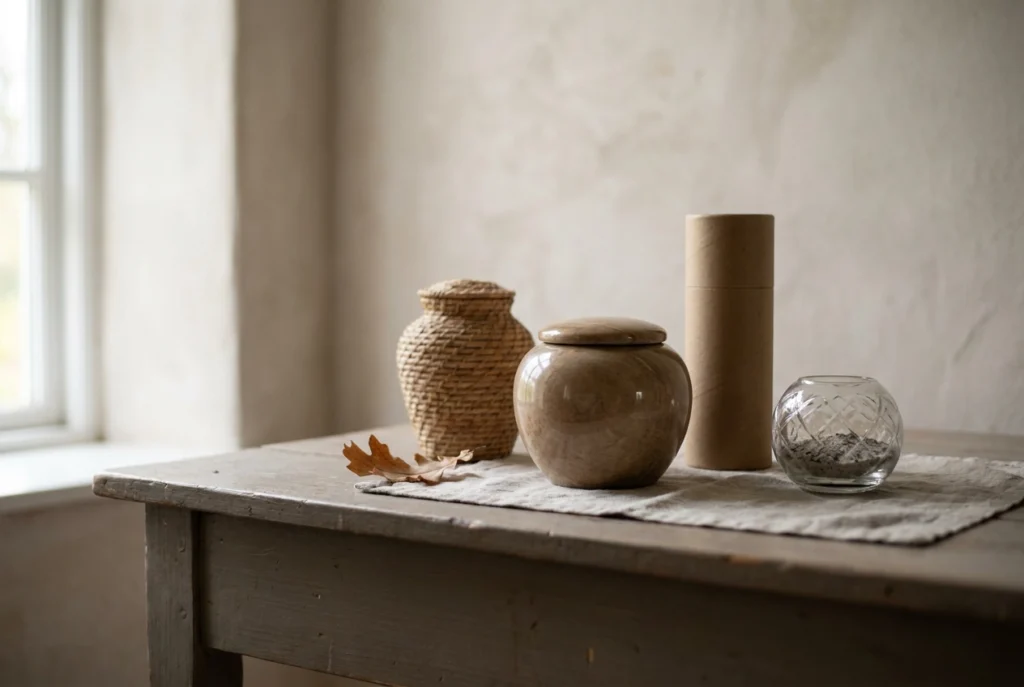
Cremation often begins with a simple choice, yet it leaves families facing a harder question: what should happen to the ashes? In Pennsylvania, that question has no single automatic answer. State law does not dictate where cremated remains may be kept or scattered, so families must weigh four practical paths: interment in a cemetery, scattering on private or public land, keeping remains at home, and dividing them among relatives. Each path carries different legal considerations and different choices about cremation urns and keepsakes, from a permanent niche to a scattering container to several small memorial pieces.
This comparison is designed for beginners who want clear, authoritative guidance before emotions and deadlines take over. You will learn why the ashes decision so often gets deferred, what Pennsylvania law actually says, and how the rules change for private land, public parks and trails, federal land, sea and inland waters, and scattering by air. You will also see how cemetery scattering gardens, home display, and divided remains work in practice, plus how to compare the options side by side and ask the right questions in advance. The goal is simple: make one decision together, early, rather than leaving conflict for later.
Why the Ashes Decision Gets Deferred
Cremation is easy to decide. What happens to the ashes is not.
When a family chooses cremation, they sign an authorization, the cremation is completed, and the remains come back in a container. At no point in that process is anyone formally asked where those ashes should ultimately rest. The question simply goes unasked. Even when a death occurs out of state and arrangements involve bringing your loved one home to Philadelphia, the paperwork covers transport, not final disposition.
So the urn goes on a shelf. Sometimes it goes in a closet. It stays there for years, because raising the subject feels like reopening a wound that has only just closed.
The conflicts that surface later are rarely about the ashes themselves. They are about who was asked, who was not, and what each person assumed everyone else already knew.
Pennsylvania law leaves much of this open. Some families experience that as freedom. Others experience it as paralysis. Both reactions are normal.
This article compares four paths: interment, scattering, keeping, and dividing. It does not recommend one. What follows takes each path in turn, along with the rules that govern it.
What Pennsylvania Law Actually Says About Cremated Remains
Pennsylvania has no state law controlling where cremated remains are kept or scattered, according to the Funeral Consumers Alliance of Pennsylvania (FCAPA).
What governs instead is a patchwork. Who owns the land, private, public, or federal, sets the first question. Waterway rules, cemetery and religious organization policies, and city and county zoning fill in the rest.
FCAPA notes remains may be stored in a crypt, a niche, a grave, or a container at home. The absence of a statute is why all four are possible. The same logic shapes home burial in Pennsylvania, where permits, timelines, and local codes, not state law, decide what is allowed.
Be careful with what silence means. State law being quiet does not clear you to scatter on land you do not own. A Greener Funeral warns that scattering laws are changing rapidly and advises families to confirm current requirements with the relevant state authority before acting.
The next sections take each path in turn: interment, then scattering by setting, then keeping and dividing.
Path One: Interment in a Cemetery
Interment gives cremated remains what scattering and home keeping do not: a fixed, recorded place. Interment usually takes one of a few forms. An urn can be buried in a grave, placed in a columbarium niche, or set in a crypt.
Call the cemetery before committing and ask four questions: does it accept cremated remains, which containers does it permit, what are the opening and closing fees, and is a marker or inscription required? A columbarium niche and ground burial usually get compared on the same points, so also ask how niche and grave options differ on space, markers, and cost before choosing between them.
No Pennsylvania statute dictates what an urn must be. That answer comes from cemetery policy, so ask before you buy. Interment calls for a durable container designed to stay sealed in place, sized to the niche or vault it enters.
Families planning a Catholic funeral should check the Church’s rules on cremation, which shape both the urn and the committal.
Scattering works differently: the rules change with the ground beneath you.
Path Two: Scattering Across Seven Settings
Scattering is the most complicated path, because the rules follow the ground or water beneath you. Seven settings get their own treatment below: private land, public land, federal land, sea, inland waters, air, and scattering gardens.
Each raises a different permission question, and no two are the same. Private land may need nothing beyond the owner’s consent. Public land may fall under city or county rules. Federal land requires a federal agency’s permission. Sea scattering falls under federal water rules, and inland waters may require a state permit.
Wherever you plan to scatter, confirm the current rules before scheduling a ceremony or gathering. Scattering laws are changing rapidly, and a site that was permissible a few years ago may not be today.
The next six sections take each setting in turn, grouping sea and inland waters together, so you can jump straight to the one your family is considering.
If you are weighing scattering against another ground-based option, whether natural burial is realistic near Philadelphia turns on the same question: what the specific site will allow.
Scattering on Private Land
Under Funeral Consumers Alliance of Pennsylvania (FCAPA) guidance, scattering on private land is permitted in Pennsylvania, and on land you do not own, the owner’s wishes govern. Get permission from that landowner and put it in writing when you can. A verbal yes is difficult to rely on years later, especially if the property changes hands.
The appeal is durability. Family farmland, a wooded parcel, or a rural property gives your family a site that may stay accessible and meaningful for decades.
Before you gather, check conditions on the ground:
- Wind direction, so remains do not blow back onto the people present
- Distance from waterways and wells, keeping remains out of water sources
- Whether the ground is planted or cultivated, since a working field may be turned, sprayed, or sold
Then write down where it happened: the address, a landmark, the date. Relatives who were not present, or who were not born yet, will otherwise have no way to find the spot.
If scattering is one part of a larger plan, review how to read a funeral home general price list and what Philadelphia families should look for before your arrangement conference, particularly if a memorial service or cemetery interment will follow.
Scattering on Public Land: Parks, Trails, and City Property
Private land gives you one clear answer: ask the owner. Public land splits that answer into layers.
The Funeral Consumers Alliance of Pennsylvania (FCAPA) advises that scattering on public land may require checking city and county regulations and zoning before you proceed. In practice, many families simply use their best judgment; that is a description of what happens, not permission. Local rules still govern.
In Northeast Philadelphia, that means Philadelphia Parks & Recreation property and watershed land carry their own policies. Ask the managing body about the specific site, whether a city park, a trail, or reservoir land, rather than assuming one statewide answer applies.
Once you have confirmed what is allowed, the common practical approach is quiet and dispersed: an out-of-the-way spot, well away from paths, picnic areas, playgrounds, and water intakes.
Etiquette follows the same logic. Avoid scattering anywhere a small gathering would draw attention, and stay clear of places grounds crews work regularly, so nothing you leave behind becomes their problem.
Next: federal land, where the rules tighten and permission is required.
Scattering on Federal Land
Scattering on federal land officially requires permission, and each agency runs its own process. The Bureau of Land Management, for instance, reviews requests case by case and may ask that remains be pulverized and scattered at least 100 yards from trails, roads, facilities, and water, with no marker left behind (BLM guidance).
FCAPA observes that quiet scattering away from trails, roads, facilities, and waterways is often tolerated in practice. Tolerance is not authorization. If the ceremony matters to your family, contact the managing agency first.
National parks, national forests, and monuments often operate under separate policies. Some parks publish their own scattering instructions and permit requirements (Great Smoky Mountains National Park), so the question is about the specific site, not the federal government in general. Federal guidance also changes. Confirm it directly with the managing agency before relying on any summary, including this one.
Where the land ends and the water begins, a second set of rules applies.
Scattering at Sea and in Inland Waters
Federal rules, not state ones, govern ocean scattering. The EPA’s general permit under the Marine Protection, Research and Sanctuaries Act allows placement of cremated remains in ocean waters, but not within three nautical miles of shore, measured from the low water mark or a charted closing line. Burial at sea must be reported to the EPA within 30 days through the agency’s online reporting tool. Verify the current distance and reporting steps against EPA guidance before you rely on any summary, including this one.
One sourcing caution: FCAPA’s sea-scattering page cites an EPA regional office that does not cover Pennsylvania. Confirm the correct regional contact before filing.
Inland waters sit outside that permit entirely. Rivers and lakes may require a permit from the state agency managing the waterway, so ask before scheduling.
Logistics get overlooked. A boat-based ceremony needs an operator willing to take passengers and calm conditions on the day. Remains also do not disperse the way most people picture; wind and water leave visible residue. Plan the meaning of the act, not a clean cinematic image.
Next: scattering by air.
Scattering by Air
Air scattering sits outside the state rules that govern inland waters. According to the Funeral Consumers Alliance of Pennsylvania, no Pennsylvania statute applies to scattering remains from an aircraft.
The constraint that does apply is federal. Under 14 CFR 91.15, the pilot in command may not drop an object that could harm people or property. That single rule shapes the practical approach: remove the ashes from the urn before the flight. A sealed container released midair is a falling object and a visible one, which invites attention no family wants.
Coordinate before you book. Talk with the pilot about altitude, timing, and route; choose a flight line that avoids homes, buildings, roads, and crowds; and confirm exactly what the operator will and will not do, since some pilots fly the route only and leave the release to the family.
Finally, plan for imprecision. Wind and altitude mean what leaves your hands is not what reaches the ground where you aimed. Treat air scattering as an act of release rather than a way to mark a specific spot, unless a fixed place to visit matters more than the gesture itself.
Scattering Gardens at Cemeteries and Houses of Worship
If scattering from the air leaves a family with no fixed place to return to, a scattering garden offers the opposite. Many cemeteries and religious organizations maintain these spaces: defined, maintained grounds where remains are placed and the operator handles upkeep. According to the Funeral Consumers Alliance of Pennsylvania (FCAPA), religious organizations generally charge far less than a commercial cemetery for this, and sometimes charge nothing at all.
The trade-off deserves stating plainly. A garden gives your family an address to visit without the cost of a niche or grave, but the space itself is chosen by an institution rather than by you. That distinction often matters more than price, which is one reason how memorialization differs from path to path is worth thinking through early.
Ask two questions before committing. What happens if the garden is reconfigured or relocated later? Is the name recorded in a register the family can request? Neither answer is standard, so get both from the specific cemetery or congregation.
Because the urn itself does not stay, a temporary or scattering container is often all this path requires.
Path Three: Keeping Remains at Home
Unlike a scattering garden, home keeping keeps the decision open. According to the Funeral Consumers Alliance of Pennsylvania (FCAPA), remains may be stored in a container at home, and Pennsylvania has no state law restricting it.
Decide early where the urn will live. A shelf, a mantel, a closet: whichever you choose becomes an emotional anchor, whether or not anyone intended that.
The advantage of a reversible choice
Keeping is the one path you can undo; scattering cannot be reversed. Holding the remains while the family weighs a cemetery plot, a scattering garden, or a private site is a legitimate long-term answer, not a delay.
What families overlook
- Young children and pets: an urn within reach invites curiosity, so choose a height or cabinet accordingly.
- A future move: plan how the remains travel and who carries them.
- The keeper’s death: name a successor, or the urn becomes an estate question.
Record the remains and the intended disposition in an estate plan or advance directive, so the next generation is not left guessing. If several relatives want a portion, that is the next path.
Path Four: Dividing Remains Among Family
Keeping remains at home keeps every option open, and division is the choice families most often improvise. Research reviewed for this article found no Pennsylvania statute establishing who holds legal authority over cremated remains after cremation. In practice, the person who arranged the cremation and received the remains usually holds the decision, so that person’s judgment carries weight even without a statute.
Splitting ashes into shares sounds fair. It often satisfies less than expected, because a share is not a place to visit. Small keepsakes make division physically workable: a portion goes into a pendant or a cremation ring while the rest stays together in one urn.
Given the legal gap, siblings should agree in writing before dividing. Name who receives what and where the remainder will rest. If your family is still weighing whether cremation itself fits, Direct Cremation in Philadelphia: What It Includes, What It Doesn’t, and How to Decide explains the trade-offs.
Urn and Keepsake Choices Each Path Implies
Each path points toward a different kind of vessel. Interment in a niche or grave generally calls for a durable, sealed cremation urn sized to fit the space the cemetery allows, so its requirements come first and style comes second. Confirm dimensions and any sealing rule before you shop. If a graveside gathering is part of the plan, Memorial vs. Funeral vs. Graveside: What’s the Difference? explains how that service differs from a memorial or a funeral.
Scattering usually requires no permanent urn at all. Some families use a container designed to open easily at the site, or one meant to break down over time. Check what the specific site permits before depending on either.
Home keeping makes display the deciding factor: size, material, and whether the urn is meant to be seen on a shelf or stored out of daily view.
Division makes small keepsakes practical. Miniature urns, pendants, and cremation rings let several family members each hold a portion while the main remains stay together in one place.
This article makes no product recommendations. The useful questions are fit, permanence, and where each object will be in twenty years.
Comparing the Paths Side by Side
The table below compresses every option covered above. Read your row, then the matching section.
| Option | Governed by | Permission | Reversible | Left behind | Suits |
|---|---|---|---|---|---|
| Cemetery interment | Cemetery policy | Cemetery’s | No | Grave or niche | Families needing a permanent place |
| Private land | Landowner | Owner’s | No | Nothing physical | Family land |
| Public land | City or county | Local rules | No | Nothing physical | Local, informal ceremonies |
| Federal land | Managing agency | Agency’s | No | Nothing physical | Those who confirm first |
| Sea | EPA permit | EPA notice | No | Nothing physical | Boaters who verify current rules |
| Inland waters | State agency | Possibly a permit | No | Nothing physical | River and lake families |
| Air | Federal law | Pilot’s | No | Nothing physical | Symbolic release |
| Scattering garden | Cemetery or religious body | Provider’s | No | Name in a register | A visitable place, lower cost |
| Home keeping | No PA law | None | Yes | The urn | Deciding later |
| Division | No PA law | Family agreement | Partly | Keepsakes | Several relatives |
Reversibility is the biggest practical difference. Keeping can change later; scattering cannot. The second difference is a fixed place to visit, which some family members need and others do not. That question settles more arguments than cost does. Use the final column to scan, then read only your path.
Deciding in Advance: Questions to Ask Each Other
The comparison table shows how much the choices differ. It cannot show how a family reaches agreement. That takes a conversation, and the earlier it happens, the easier it is.
Three questions cover most of the ground:
- Does anyone need a fixed place to visit?
- Does anyone want to carry a portion?
- Who will keep the remains until the decision is made?
Ask these before cremation, while arrangements are still open and no one feels second-guessed afterward.
Put the answers in writing, even informally, and tell the funeral home so the plan is recorded and can be found by the next person who needs it.
When agreement stalls, the reversibility point above is the tie-breaker.
Revisit the decision after a major family change, such as a move, a death, or a new generation arriving. What suited a family five years ago may not suit it now.
Where a Funeral Home Fits In
John F. Fluehr & Sons, Inc. is a family-owned funeral home that has served families in Northeast Philadelphia since 1898. Its stated offerings include cremation, funeral services, memorial services, and celebrations of life.
Whatever your family decides, that decision is separate from the cremation itself. You can plan it with a funeral home, or you can handle it entirely on your own. Pennsylvania does not require a funeral director.
What families often miss is that the two decisions interact. If you are planning a memorial service or a celebration of life, where the remains will rest frequently shapes the service itself: what is displayed, whether an urn is present, where guests gather afterward. Planning them together usually produces a more coherent result than deciding the service first and the disposition later.
Recording the decision matters. When the choice is documented with a funeral home, a sibling, a child, or a grandchild can find it instead of reconstructing what was wanted. That record prevents the second-guessing described earlier.
Urns and keepsakes remain the family’s choice; the firm’s documented offerings are services, not products.
Conclusion: Four Paths, One Decision to Make Early
Whether you record your plan with a funeral home or handle everything yourselves, the same truth anchors every path in this guide: Pennsylvania has no state law governing where ashes are kept or scattered. That silence hands the decision to your family, not the state.
Before any ceremony, run the verification checklist:
- Private land: get the owner’s permission, ideally in writing.
- Public land: check city and county rules.
- Federal land: contact the managing agency.
- Sea: notify the EPA.
- Inland waters: confirm whether a permit is required.
Choose deliberately among burial, scattering, keeping, and dividing. Letting an urn sit on a shelf is a default, not a decision.
Then write it down and tell two people: your funeral home and your family. A plan that lives only in your head does not survive you.
One habit protects all of it: recheck current rules before any planned ceremony. Scattering laws continue to change, and a plan made five years ago may not match today’s requirements.